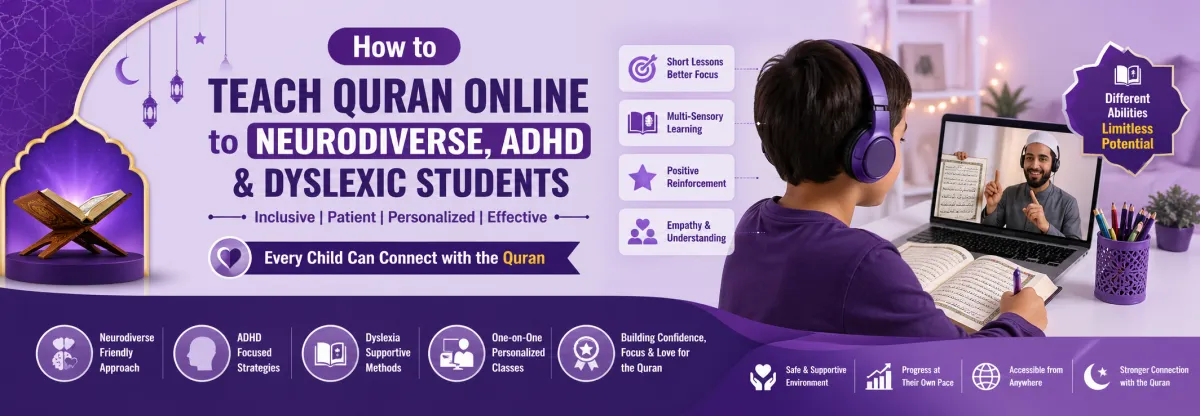
Inclusive Teaching Guide | How to Teach Quran Online to Neurodiverse, ADHD & Dyslexic Students
How to Teach Quran Online to Neurodiverse, ADHD & Dyslexic Students
Teaching the Quran online to neurodiverse learners—including students with ADHD and dyslexia—requires a structured, flexible, and highly personalized instructional approach. Traditional teaching methods often fail to address cognitive diversity, making it essential for Quran educators to adopt inclusive, evidence-based teaching strategies.
This guide provides a professional framework for delivering effective, engaging, and accessible online Quran education for neurodiverse students.
Understanding Neurodiverse Quran Learners
Neurodiversity refers to variations in brain function and learning styles. In Quran education, the most common learning differences include:
ADHD (Attention-Deficit/Hyperactivity Disorder)
Short attention span
Difficulty maintaining focus during recitation
Need for movement and interaction
Dyslexia
Difficulty recognizing Arabic letters and phonetic patterns
Slower reading pace
Challenges in Tajweed application
General Neurodiverse Traits
Preference for visual or auditory learning
Need for repetition and structure
Sensitivity to overwhelming content
Understanding these traits allows teachers to design targeted Quran learning experiences rather than applying a one-size-fits-all model.
Core Principles of Teaching Quran to Neurodiverse Students
1. Personalization Over Standardization
One-on-one Quran classes are significantly more effective than group sessions for neurodiverse learners. Personalized pacing ensures:
Reduced cognitive overload
Better retention
Stronger teacher-student connection
2. Multi-Sensory Teaching Approach
Engage multiple senses to enhance learning:
Visual: Color-coded Tajweed rules
Auditory: Repetition of recitation
Kinesthetic: Writing or tracing Arabic letters
This method strengthens neural connections and improves memorization.
3. Structured & Predictable Lessons
Neurodiverse students perform better with consistency:
Fixed lesson routine
Clear learning objectives
Short, manageable tasks
Example structure:
Warm-up (revision)
New lesson (5–10 minutes)
Practice session
Positive feedback
Effective Strategies for ADHD Quran Students
Keep Lessons Short and Focused
20–30 minute sessions
Break lessons into micro-tasks
Use Interactive Teaching Tools
Screen sharing with highlighted text
Digital whiteboards
Gamified quizzes
Frequent Engagement
Ask questions every few minutes
Encourage recitation repetition
Use reward-based motivation
Effective Strategies for Dyslexic Quran Students
Use Simplified Arabic Text
Large fonts
Increased spacing between letters
Clear, distraction-free layout
Phonetic-Based Learning
Focus on sound recognition before full reading:
Break words into syllables
Repeat pronunciation slowly
Repetition & Reinforcement
Daily revision
Audio-assisted learning
Step-by-step Tajweed practice
Best Online Tools for Teaching Quran
To enhance accessibility and engagement:
Zoom / Google Meet: Live interactive classes
Digital Whiteboards: Visual explanation of Tajweed
Quran Apps with Audio: Reinforce pronunciation
Screen Annotation Tools: Highlight mistakes in real-time
Importance of Teacher Training in Special Needs Education
A qualified Quran teacher for neurodiverse students should have:
Understanding of ADHD and dyslexia
Patience and emotional intelligence
Ability to adapt teaching methods dynamically
Professional training ensures inclusive and effective Quran education delivery.
Creating a Supportive Learning Environment
For Teachers
Maintain calm and encouraging tone
Avoid pressure or strict correction
Celebrate small achievements
For Parents
Provide a distraction-free learning space
Stay involved in revision
Communicate regularly with the teacher
Common Mistakes to Avoid
Overloading students with long lessons
Using rigid teaching methods
Ignoring individual learning pace
Lack of visual and auditory support
Avoiding these mistakes significantly improves student engagement and retention.
Benefits of Adaptive Quran Teaching
Improved focus and comprehension
Increased confidence in recitation
Stronger spiritual connection with the Quran
Higher long-term retention rates
Conclusion
Teaching Quran online to neurodiverse, ADHD, and dyslexic students is not just possible it can be highly effective when done correctly. By implementing adaptive teaching methods, personalized instruction, and multi-sensory learning techniques, educators can create a meaningful and impactful Quran learning experience for every student.
Institutes that embrace inclusive education will not only improve learning outcomes but also expand their reach to underserved learners globally.