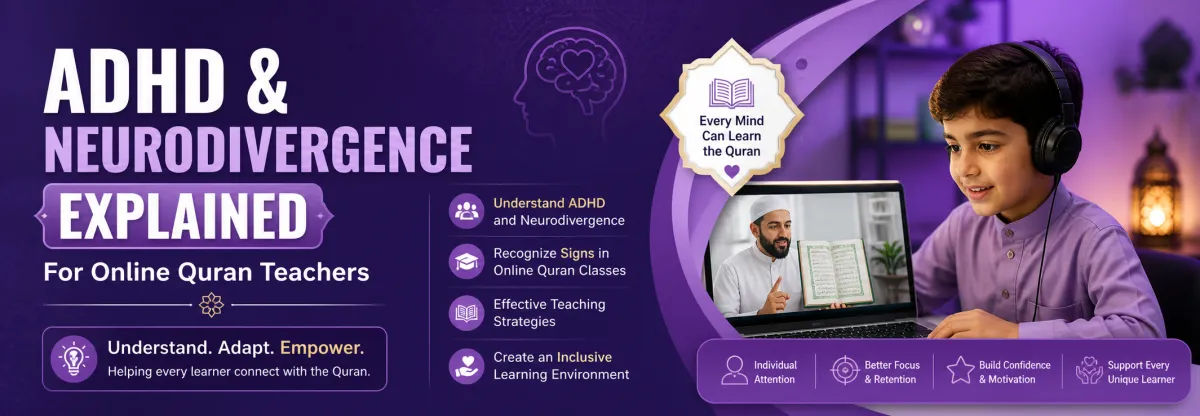
🧠 ADHD & Neurodivergence Explained for Online Quran Teachers
Introduction
Teaching the Quran online requires more than subject expertise it demands adaptability to different learning needs. Among these, ADHD (Attention Deficit Hyperactivity Disorder) and neurodivergence are increasingly common in students enrolling in online Quran classes.
Understanding how these conditions affect learning behavior is essential for Quran teachers who want to deliver effective, engaging, and inclusive lessons.
What is ADHD in the Context of Quran Learning?
ADHD is a neurodevelopmental condition that affects a student’s ability to focus, regulate attention, and manage impulses.
Common Signs in Online Quran Classes:
Difficulty staying focused during recitation
Frequent distraction or switching tasks
Struggles with memorization (Hifz)
Impulsive reading without Tajweed accuracy
Restlessness during longer sessions
For Quran teachers, this means traditional teaching methods may not always work effectively.
What Does Neurodivergent Mean?
Neurodivergence refers to variations in how the brain functions and processes information. This includes:
ADHD
Dyslexia
Autism Spectrum
Learning differences
In online Quran education, neurodivergent students may:
Learn better visually rather than verbally
Require repetition and structured lessons
Respond differently to correction and feedback
Why This Matters in Online Quran Teaching
Unlike physical classrooms, online Quran classes rely heavily on:
Screen attention
Audio clarity
One-on-one interaction
For ADHD and neurodivergent learners, these factors can either improve or worsen their learning experience depending on how lessons are structured.
Effective Teaching Strategies for ADHD & Neurodivergent Students
1. Short & Structured Lessons
Break lessons into smaller segments (10–15 minutes per activity) to maintain attention.
2. Use Visual & Interactive Tools
Incorporate:
Highlighted Quran text
Screen annotations
Visual Tajweed rules
3. One-on-One Focused Learning
Personalized sessions significantly improve engagement for ADHD students.
4. Repetition with Variation
Repeat verses in different ways:
Listening
Recitation
Writing (if applicable)
5. Positive Reinforcement
Encourage progress rather than correcting every mistake immediately.
6. Flexible Teaching Approach
Adapt your pace based on:
Student mood
Attention span
Learning response
Common Mistakes Quran Teachers Should Avoid
Long, uninterrupted lessons
Overloading students with corrections
Ignoring attention limitations
Using one teaching method for all students
Benefits of ADHD Friendly Quran Classes
When teaching methods are adapted:
Students show better focus
Tajweed improves gradually
Memorization becomes easier
Confidence increases
Parents report higher satisfaction
Conclusion
Understanding ADHD and neurodivergence is no longer optional for online Quran teachers it’s essential. By adapting teaching strategies and creating a supportive learning environment, teachers can help every student succeed, regardless of their learning differences.
Inclusive Quran teaching not only improves student outcomes but also strengthens your reputation as a professional and effective online Quran tutor