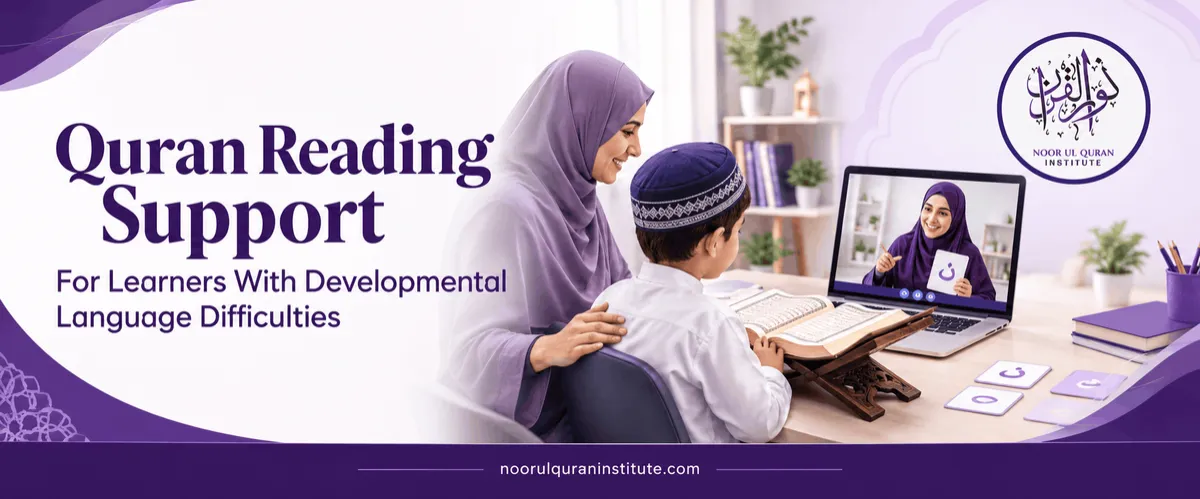
Quran Reading Support for Learners With Developmental Language Difficulties
Learning to read the Quran is a meaningful journey, but some learners need additional support to recognize Arabic letters, understand verbal instructions, remember sounds, or pronounce words clearly. For children with developmental language difficulties, a structured and patient teaching approach can make Quran lessons easier to follow and more comfortable.
Every learner develops at a different pace. Some children may recognize Arabic letters but struggle to connect them into words, while others may need repeated demonstrations before remembering a new sound. With individualized instruction, manageable learning goals, and regular practice, families can help learners build Quran reading skills without unnecessary pressure.
This guide explains practical Quran reading strategies for learners with developmental language difficulties and how parents can choose appropriate online Quran learning support.
Understanding Developmental Language Difficulties in Quran Learning
Developmental language difficulties can affect how a person understands language, expresses ideas, or processes verbal information. These challenges may influence classroom participation, following instructions, remembering explanations, and learning unfamiliar vocabulary.
During Quran lessons, a learner might need more time to understand a teacher's directions, remember Arabic letter sounds, or follow a sequence of reading steps. However, these difficulties vary considerably. A child who struggles to understand spoken instructions may have different needs from one who has difficulty expressing words or distinguishing particular speech sounds.
It is important not to assume that every learner with language difficulties will experience the same Quran reading challenges. Parents and teachers should observe the learner's individual strengths and needs before deciding which teaching methods to use.
Common Quran Reading Challenges for Learners With Language Difficulties
1. Recognizing and Remembering Arabic Letters
Arabic letters may initially look unfamiliar to children who are more accustomed to another writing system. Learners might confuse letters with similar shapes or need additional practice remembering their names and sounds.
Teachers can introduce a small number of letters at a time, use clear visual examples, and revisit previously learned letters during each session. Short activities that involve identifying, naming, and matching letters can help reinforce recognition.
2. Connecting Letters With Their Sounds
Reading requires learners to connect written symbols with spoken sounds. Some children may recognize an Arabic letter when shown individually but find it more challenging to recall its sound while reading a word.
A teacher can demonstrate the letter sound, invite the learner to repeat it when comfortable, and then practice identifying the letter in different examples. Consistent demonstrations and guided repetition can help learners become more familiar with Arabic letter-sound relationships.
3. Following Multi-Step Instructions
Instructions such as identifying a letter, reading its vowel sound, joining it with another letter, and reciting the resulting word may be difficult for learners who need additional language-processing support.
Instead of presenting several instructions together, teachers can divide the task into smaller steps. For example, the learner can first identify the letter, then practice its sound, and finally attempt to read it in a simple combination.
4. Remembering Previously Learned Material
Some learners may perform well during a lesson but struggle to recall the same letters or reading patterns in the following session. This does not necessarily mean that they are unable to learn the material.
Brief revision activities, familiar examples, and repeated opportunities to practice can help reinforce learning. Teachers should review progress regularly and adjust the amount of new material according to the learner's response.
5. Developing Clear Quran Pronunciation
Arabic pronunciation involves specific letter sounds and articulation points. Learners may need additional demonstrations to distinguish unfamiliar sounds or become comfortable with Quran recitation.
Teachers can model individual sounds slowly, demonstrate mouth positioning where appropriate, and provide gentle corrective feedback. Pronunciation should be developed gradually rather than expecting learners to master every Tajweed rule at once.
Effective Quran Reading Strategies for Learners With Developmental Language Difficulties
1. Begin With a Simple Learning Assessment
Before introducing a new lesson, a Quran teacher can explore what the learner already knows. This may include recognizing Arabic letters, identifying short vowel marks, reading simple combinations, and following basic instructions.
The purpose is not to diagnose a developmental condition. Instead, it is to identify an appropriate starting point for Quran reading instruction.
A simple assessment can help the teacher establish realistic learning goals and avoid presenting material that is unnecessarily difficult or repetitive.
2. Teach Arabic Letters Step by Step
A structured approach can make Quran reading more manageable. Begin with familiar or easier-to-distinguish letters, introduce their sounds, and gradually move toward vowel marks and connected letter forms.
The teacher can use the following sequence:
Recognize an Arabic letter.
Learn and practice its sound.
Identify basic vowel marks such as Zabar, Zer, and Pesh.
Read simple letter combinations.
Practice joining letters into words.
Progress toward short Quranic words and passages when ready.
The pace should depend on the learner's understanding and comfort, not a fixed timetable.
3. Use Noorani Qaida to Build Reading Foundations
Noorani Qaida provides a structured introduction to Arabic letters, vowel sounds, letter combinations, and foundational Quran reading skills. It can be a useful starting point for learners who need systematic practice before reading longer Quranic passages.
Teachers can adapt the pace by covering fewer examples per session, revisiting difficult letters, and checking understanding before moving forward.
Explore Noorani Qaida lessons to learn more about this foundational course.
4. Combine Visual Demonstrations With Listening
Some learners benefit from seeing a letter while hearing its sound. Teachers can display a clear Arabic letter, pronounce it, and invite the learner to identify or repeat it.
Simple visual prompts, pointing activities, and matching exercises can reinforce the relationship between written Arabic letters and their sounds.
The teacher should observe which supports are helpful for the individual learner rather than assuming that one teaching style will suit everyone.
5. Keep Lessons Short and Structured
Long lessons containing many new concepts may become overwhelming for learners who need extra processing time. A more manageable session can focus on one or two specific learning goals.
For example, a lesson might cover recognizing three familiar letters, reviewing their sounds, and practicing a few simple combinations. The teacher can include short breaks when needed and finish with a familiar activity to reinforce confidence.
Lesson length should be adjusted according to the learner's age, attention, comfort, and individual needs.
6. Use Repetition Without Creating Pressure
Repeated practice can help learners become more familiar with Arabic letters and pronunciation patterns. However, repetition should remain supportive rather than turning into a stressful test.
Teachers can revisit previously learned examples, model a difficult sound again, or use a familiar letter in a new word. Positive feedback should recognize effort, participation, and gradual improvement.
When a learner makes a mistake, the teacher can demonstrate the correct sound and provide another opportunity to practice without criticism.
7. Introduce Tajweed Gradually
Tajweed teaches the principles of correct Quranic recitation, including articulation points and pronunciation rules. For a beginner who needs language-learning support, it may be more appropriate to establish basic letter recognition and reading foundations before introducing several rules together.
Once the learner is ready, the teacher can introduce relevant Tajweed concepts through clear examples and guided recitation.
Learn more about online Tajweed classes and the role of correct Arabic pronunciation in Quran reading.
How One-to-One Online Quran Classes Can Help
Individualized online Quran lessons allow a teacher to focus on one learner's current reading skills, practice needs, and learning pace. This format can be particularly useful when a child needs additional time to understand instructions or practice specific Arabic sounds.
Potential benefits include:
Individual attention: The teacher can focus on the learner's current difficulties instead of following a group pace.
Flexible lesson structure: Teachers can divide reading tasks into smaller steps and revisit challenging concepts.
Repeated demonstrations: Learners can hear and observe a pronunciation example more than once.
Personalized practice: Exercises can focus on letter recognition, connected letters, vowel marks, or recitation as needed.
Progress monitoring: Parents and teachers can discuss which skills are improving and which require more practice.
These benefits depend on the teacher's approach and the learner's individual needs. Online Quran lessons are educational support; they do not replace speech-language therapy or other professional services when those are needed.
Parents can also read about how one-to-one online Quran classes help students learn faster to understand the benefits of individualized instruction.
Choosing a Patient Quran Teacher
Choosing an appropriate teacher is an important step when arranging Quran reading support for a child with developmental language difficulties.
Parents should look for a teacher who:
Uses clear, simple instructions.
Gives the learner enough time to respond.
Breaks unfamiliar concepts into smaller steps.
Provides patient and respectful pronunciation feedback.
Adjusts the lesson according to the learner's progress.
Communicates regularly with parents about learning goals.
Understands that learners may need different types of support.
Parents should also explain the child's learning needs before lessons begin. If the child receives guidance from a speech-language therapist or another qualified professional, parents can ask that professional for suggestions that may be useful during Quran learning.
For additional guidance, explore how to choose the right online Quran teacher for your child.
How Parents Can Support Quran Reading Practice at Home
Parents can reinforce lessons by creating a calm and predictable practice routine. Consistency is generally more useful than expecting a child to complete a large amount of work in one sitting.
Consider these practical steps:
Choose a comfortable time: Practice when the learner is reasonably rested and ready to participate.
Review familiar letters: Begin with examples the child has already learned.
Practice one skill at a time: Focus on a small goal, such as recognizing a letter or recalling its sound.
Use the teacher's examples: Keep practice consistent with the methods used during lessons.
Celebrate progress: Recognize effort and small achievements without comparing the child with others.
Share observations: Tell the teacher which activities seem easy or difficult at home.
Parents can use a simple progress record to note the letters practiced, the level of prompting needed, and the skills that should be reviewed next. Avoid turning every practice session into a formal assessment.
For more ideas, read how parents can track their child's progress in online Quran classes.
When Additional Professional Support May Be Helpful
If a child consistently struggles to understand language, follow everyday instructions, express ideas, or develop speech and language skills, parents may wish to discuss these concerns with a qualified healthcare professional or speech-language therapist.
A speech-language therapist can assess communication needs and recommend appropriate strategies. With parental consent, useful recommendations may also inform how a Quran teacher presents instructions and supports practice.
It is important to distinguish language difficulties from other learning or communication differences. A Quran teacher should not diagnose a developmental language disorder based on reading performance alone.
The goal is to provide appropriate educational support while ensuring that the learner can access professional assessment or intervention when needed.
Frequently Asked Questions
Can children with developmental language difficulties learn to read the Quran?
Many children with developmental language difficulties can develop Quran reading skills with appropriate instruction. Their learning needs, starting abilities, and pace vary, so lessons should be adapted to the individual rather than based on a fixed expectation.
Is Noorani Qaida suitable for learners who struggle with language?
Noorani Qaida can provide a structured introduction to Arabic letters, vowel marks, and reading combinations. A teacher may adjust the pace, reduce the number of new examples, and provide additional revision according to the learner's needs.
How can a Quran teacher help a child who struggles to remember Arabic letters?
The teacher can use repeated demonstrations, clear visual examples, letter-sound matching, short revision activities, and gradual progression. If a particular method is not helping, the teacher can try another approach.
Are online Quran classes suitable for children with communication difficulties?
They may be suitable for some learners, especially when lessons provide individualized attention, clear instructions, and flexible pacing. Parents should consider the child's comfort with the online format, communication needs, and ability to participate.
Should Tajweed be taught before a child can read Arabic letters confidently?
Teaching should follow the learner's current abilities. Many beginners benefit from developing letter recognition, basic sounds, and simple reading skills before studying more complex Tajweed concepts.
How often should a child practice Quran reading?
The appropriate frequency depends on the child's age, needs, schedule, and response to practice. Short, manageable sessions on a consistent schedule may be a useful starting point. Parents and teachers can adjust the routine as the learner progresses.
Support Your Child's Quran Reading Journey
Every learner deserves a respectful and encouraging opportunity to develop Quran reading skills. For children with developmental language difficulties, clear instructions, step-by-step Arabic letter practice, patient teaching, and realistic learning goals can help make lessons more accessible.
Parents can explore Noor ul Quran Institute's Quran learning programs to learn about available online Quran education options. Discuss your child's learning needs before selecting a course so that the teaching approach can be matched to the learner as closely as possible.
With appropriate support and consistent practice, Quran learning can become a more manageable and positive experience for the whole family.