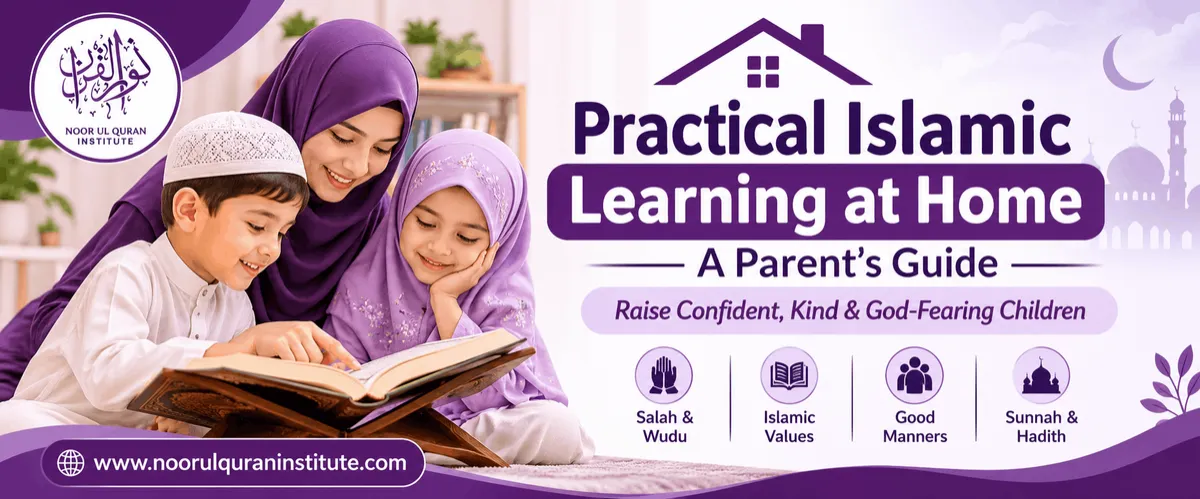
Practical Islamic Learning at Home: A Parent's Guide
Children develop their understanding of Islam through more than formal lessons. Everyday family routines, conversations, shared activities, and the examples they observe at home all contribute to their Islamic upbringing. Parents can make learning meaningful by connecting Islamic teachings with situations children experience in their daily lives.
Islamic learning at home for kids does not have to mean arranging long study sessions or introducing several subjects at once. It can begin with small, consistent activities that help children understand their faith, develop positive habits, and gradually become more confident in practicing Islam.
This guide explains how parents can create a supportive home environment for Islamic learning, encourage consistent practice, and connect everyday experiences with age-appropriate Islamic education.
Why Is Home-Based Islamic Learning Important for Children?
Home is one of the first environments where children observe how values and responsibilities are practiced. They notice how family members speak, interact, show gratitude, and make decisions. These everyday experiences can become opportunities to reinforce what children learn about Islam.
A supportive home learning environment helps children:
Connect Islamic teachings with familiar daily situations.
Develop an interest in learning about their faith.
Build consistency through manageable routines.
Ask questions and discuss what they do not understand.
Recognize the importance of good character and responsibility.
Become more comfortable practicing what they learn in structured lessons.
Parents do not need to act as the only source of Islamic instruction. Their role can be to encourage curiosity, reinforce age-appropriate lessons, and seek qualified guidance whenever a question requires deeper Islamic knowledge.
1. Make Islamic Learning Part of Everyday Family Life
One practical way to introduce Islamic learning is to connect it with activities that already happen during the day. Instead of treating every Islamic lesson as a separate task, parents can use familiar moments to encourage reflection and discussion.
For example:
During family meals, remind children about gratitude and good eating habits.
Before bedtime, create a few minutes for a short Islamic discussion or a familiar Dua.
During family conversations, encourage respectful speech and thoughtful listening.
When children help with household tasks, discuss responsibility, cooperation, and consideration for others.
During family time, read an age-appropriate Islamic story and ask children what they learned from it.
These activities help children recognize that Islamic values are relevant beyond a classroom or scheduled lesson.
The aim is not to turn every family activity into a formal lecture. Short, natural conversations are often easier for young children to understand and remember.
2. Build Consistent Islamic Habits Through Simple Routines
Consistency is more helpful than introducing too many activities at once. Children may find it difficult to follow a complicated routine, especially when they also have schoolwork, playtime, and family responsibilities.
Parents can begin with a few manageable activities and gradually introduce others as children become comfortable.
A simple family routine might include:
Morning: Begin the day with a short Dua or a reminder of gratitude.
During the day: Encourage good conduct, helpfulness, and responsibility through everyday situations.
Prayer times: Support children in becoming familiar with the family's Salah routine.
Evening: Spend a few minutes reviewing an Islamic lesson, story, or positive experience from the day.
Before bedtime: Encourage a calm routine that includes appropriate daily supplications.
The routine should remain flexible. School schedules, weekends, family commitments, and children's individual needs may require adjustments.
For parents looking for guidance on structured Islamic learning, the Basic Fiqh course for children provides a dedicated learning pathway covering subjects such as purification, Salah, fasting, Zakat, and Halal and Haram.
3. Help Children Become Familiar With Salah and Wudu Practice
Salah and purification are important parts of a child's Islamic learning journey. However, children may need time, repetition, encouragement, and appropriate instruction before they become comfortable with these practices.
Parents can support this learning by creating a positive environment at home.
Consider these approaches:
Let children observe appropriate family routines around prayer.
Give gentle reminders instead of turning every missed opportunity into a disagreement.
Encourage questions when children are unsure about a practice.
Recognize their efforts and progress.
Make time for guided learning rather than expecting children to understand everything independently.
For detailed instruction about Islamic rulings and the correct practices of Salah and purification, parents can explore the Basic Fiqh course for kids.
The home environment should reinforce learning, while specific religious instructions should be taught through reliable Islamic guidance.
4. Teach Responsibility Through Age-Appropriate Activities
Children can gradually learn that being part of a Muslim family includes responsibilities toward themselves and others.
Rather than giving children several expectations at once, parents can introduce simple responsibilities according to their age and understanding.
For younger children, this might involve putting away their belongings, helping keep shared spaces tidy, or remembering a simple family routine.
Older children may be ready to take more responsibility for organizing their study time, helping younger siblings, or completing agreed household tasks.
Parents can use these moments to discuss:
Keeping promises and completing responsibilities.
Being considerate of other family members.
Looking after personal belongings.
Showing gratitude for help and support.
Understanding the difference between personal choices and responsibilities toward others.
These are practical opportunities to discuss Islamic values without turning every household task into a detailed Fiqh lesson.
For structured instruction about Islamic obligations and everyday rulings, parents can refer to the Fiqh course for children.
5. Connect Islamic Values With Real-Life Situations
Children understand values more easily when they can relate them to situations they recognize. Parents can use everyday experiences to encourage reflection about how Islamic teachings guide behavior.
For example, when siblings disagree, parents can discuss patience, fairness, and respectful communication. When a child admits a mistake, parents can encourage honesty and explain why taking responsibility matters.
Other opportunities include:
Discussing kindness when children interact with friends.
Encouraging respect during conversations with parents and elders.
Talking about fairness when siblings share toys or household items.
Appreciating helpful behavior instead of focusing only on mistakes.
Encouraging children to think about how their actions affect others.
For more focused reading about Islamic manners and character, explore Islamic manners for kids.
Parents can also use Islamic stories for children to introduce moral lessons through age-appropriate examples.
6. Introduce Hadith and Sunnah Through Guided Learning
Children can gradually become familiar with the teachings and example of Prophet Muhammad ﷺ through simple, age-appropriate learning activities.
Parents can support this process by discussing a lesson after a structured class, reading a short passage together, or asking children how a teaching might relate to a situation at home or school.
For example, after discussing a lesson about kindness, parents can ask children to think of one practical way to show kindness during the day.
A useful approach is to:
Introduce one short lesson at a time.
Explain its meaning in language the child understands.
Discuss a familiar situation where the lesson may be relevant.
Encourage the child to reflect on its practical application.
Revisit the lesson later to strengthen understanding.
Parents who want structured instruction can explore the Hadith course for kids, which focuses on selected Hadith, simple meanings, and practical lessons for children's daily lives.
7. Choose Islamic Activities According to Your Child's Age
Children have different attention spans, interests, and levels of understanding. A learning activity that works well for an older child may not be suitable for a younger one.
Parents should adapt activities to their child's developmental stage instead of expecting every child to learn in the same way.
For younger children
Keep activities short, interactive, and familiar.
Ideas include:
Listening to age-appropriate Islamic stories.
Learning simple daily Duas.
Recognizing positive behavior in everyday situations.
Participating in family routines.
Using simple questions to encourage curiosity.
For primary-school children
Introduce activities that encourage participation and understanding.
Ideas include:
Reading short Islamic stories together.
Discussing the meaning of familiar Islamic practices.
Creating a simple weekly learning chart.
Reviewing lessons from structured Islamic classes.
Discussing practical examples of honesty, patience, and responsibility.
For older children
Encourage deeper reflection and greater independence.
Ideas include:
Discussing questions about Islamic values.
Reflecting on lessons from Hadith.
Taking responsibility for a manageable learning routine.
Discussing how Islamic teachings relate to school and social situations.
Reviewing previous lessons and identifying areas where further guidance is needed.
The objective is steady development, not completing a fixed number of activities or lessons.
8. Encourage Children Without Creating Learning Pressure
A positive learning environment can influence how children feel about Islamic education. If every activity becomes a test or a source of criticism, children may begin to associate learning with pressure.
Parents can encourage a healthier approach by:
Appreciating effort and gradual improvement.
Giving children time to ask questions.
Avoiding comparisons between siblings or other children.
Keeping learning sessions manageable.
Allowing children to revisit difficult subjects.
Responding calmly when children make mistakes.
Celebrating consistency rather than expecting immediate perfection.
It is also important to recognize that children learn at different speeds. Some may enjoy reading and discussion, while others respond better to stories, repetition, or guided activities.
A flexible approach helps parents support individual learning needs while maintaining clear and appropriate expectations.
9. Combine Home Practice With Structured Islamic Education
Home-based activities can reinforce a child's learning, but parents may not always have the time or subject knowledge to explain every Islamic topic in detail.
Structured instruction can help children learn from qualified teachers, follow an organized curriculum, and receive guidance suited to their current level.
Noor ul Quran Institute offers different learning options for children, including:
Islam for Kids for an introduction to Islamic learning, stories, morals, and foundational topics.
Basic Fiqh for Kids for learning essential Islamic rulings and practices.
Hadith for Kids for selected Hadith, meanings, and practical lessons.
Islamic Stories for Kids for age-appropriate stories and character-building lessons.
Parents can choose a suitable learning option according to their child's age, current knowledge, and educational needs.
The purpose of combining structured lessons with home practice is to give children opportunities to revisit what they learn and connect it with everyday experiences.
10. Create a Simple Weekly Islamic Learning Plan
A weekly plan can help parents introduce variety without overwhelming children. It does not need to be complicated or followed perfectly every day.
Here is an example that families can adapt:
DaySuggested home activityMondayDiscuss one Islamic value through a familiar situationTuesdayReview a short Dua or an existing lessonWednesdayRead an age-appropriate Islamic storyThursdayDiscuss a simple lesson from HadithFridayReflect on family Salah routines and positive habitsSaturdayReview the week's learning togetherSundayChoose one small learning goal for the coming week
This is a flexible example, not a religiously prescribed schedule. Parents can change the activities according to their family's routine and the child's learning level.
A few focused minutes of meaningful interaction may be more manageable than long sessions that are difficult to maintain.
How Can Parents Know Whether Their Child Is Making Progress?
Progress in Islamic learning is not measured only by the number of lessons completed or facts memorized. Parents can also observe whether children are becoming more comfortable discussing what they learn and applying age-appropriate lessons in daily situations.
Useful signs of progress may include:
Greater interest in asking questions about Islam.
Improved familiarity with previously introduced lessons.
More consistent participation in family learning routines.
Better understanding of simple Islamic concepts.
Increased confidence in discussing everyday situations.
A willingness to revisit and practice familiar lessons.
Parents should avoid expecting immediate or identical results from every child. Progress may be gradual, and some subjects require repeated instruction and qualified guidance.
Regular communication with a child's Islamic teacher can also help parents understand what is being covered in lessons and how they can reinforce it at home.
Frequently Asked Questions
How can I start Islamic learning at home for my child?
Begin with a few simple activities that fit naturally into family life. You can introduce short Islamic discussions, familiar Duas, age-appropriate stories, and positive daily routines. Gradually add more activities as your child becomes comfortable.
At what age should children start learning about Islam?
Children can become familiar with simple Islamic ideas and family practices from an early age. The activities and explanations should be appropriate to their understanding, attention span, and developmental stage.
How can I make Islamic learning interesting for children?
Use stories, conversations, interactive activities, repetition, and practical examples. Encourage questions and allow children to participate instead of relying entirely on long explanations.
Should parents teach Fiqh at home?
Parents can reinforce age-appropriate lessons and help children understand familiar practices. For detailed explanations of Islamic rulings, it is important to seek reliable instruction from qualified teachers and scholars.
How can I help my child remain consistent with Islamic habits?
Start with manageable routines, provide gentle reminders, appreciate effort, and avoid introducing too many expectations at once. Consistency becomes easier when activities fit naturally into the family's daily schedule.
Can online Islamic classes support learning at home?
Yes. Structured online classes can provide children with organized lessons and teacher guidance, while parents reinforce appropriate learning through everyday activities at home.
Support Your Child's Islamic Learning Journey
Building a meaningful Islamic learning environment begins with small, consistent steps. Parents can encourage curiosity, reinforce positive habits, and help children connect what they learn with everyday family life.
When home practice is supported by structured Islamic education, children have more opportunities to revisit lessons, ask questions, and develop their understanding gradually.
Noor ul Quran Institute offers learning options for children in areas such as foundational Islamic education, Fiqh, Hadith, and Islamic stories.
Explore the Islam for Kids course, review the available children's Islamic learning options, or claim a free three-day trial to explore a suitable learning path for your child.