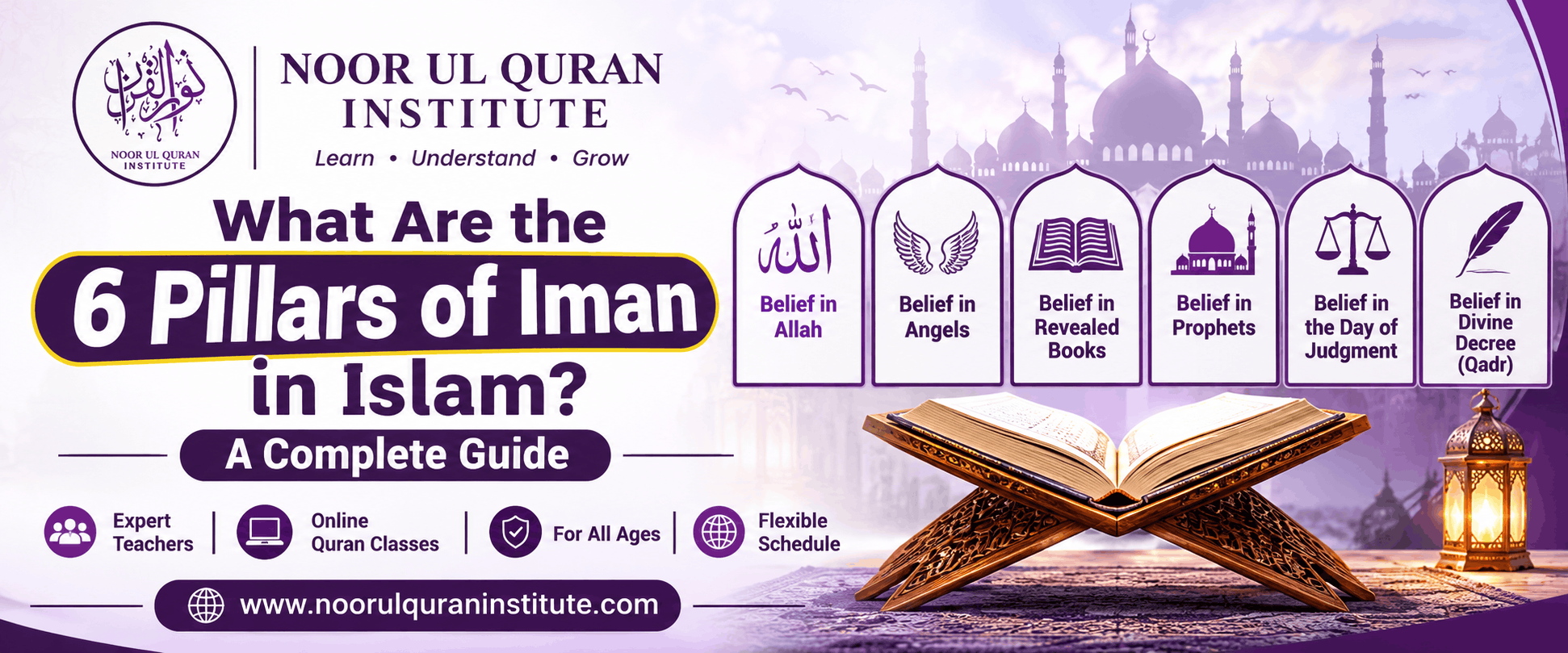
What Are the 6 Pillars of Iman in Islam? A Complete Guide
Iman is the foundation of a Muslim's faith and relationship with Allah. It shapes how Muslims understand their purpose, worship their Creator, follow His guidance, and prepare for the Hereafter. In Islam, the six pillars of Iman represent the essential beliefs that every Muslim must accept.
These six articles of faith include belief in Allah, His angels, His revealed books, His messengers, the Day of Judgment, and divine decree (Qadr). Understanding these Islamic beliefs helps Muslims develop spiritual awareness, strengthen their connection with Allah, and live according to the teachings of the Quran and Sunnah.
Whether learning about Islam for the first time or teaching children about Islamic aqeedah, understanding the six pillars of faith provides a strong foundation for a meaningful Muslim life.
What Is Iman in Islam?
Iman means faith, belief, and conviction. In Islamic teachings, it refers to believing in the fundamental truths revealed by Allah through His messengers.
Iman is more than simply knowing Islamic teachings. It involves sincere belief in the heart and a willingness to follow Allah's guidance.
The importance of Iman is explained in the Quran:
"Each one believes in Allah, His angels, His books, and His messengers." (Surah Al-Baqarah 2:285)
This verse highlights the essential beliefs that form the foundation of Islamic faith.
A Muslim's Iman influences everyday decisions, personal behavior, worship, relationships, and moral responsibilities. Strong faith encourages honesty, patience, gratitude, kindness, and trust in Allah.
What Are the Six Pillars of Iman in Islam?
The six pillars of Iman are:
Belief in Allah.
Belief in the Angels of Allah.
Belief in the Revealed Books.
Belief in the Prophets and Messengers.
Belief in the Day of Judgment.
Belief in Divine Decree (Qadr).
These six beliefs are established in the famous Hadith of Jibreel (Gabriel), in which Prophet Muhammad ﷺ explained the meaning of Iman.
Let's understand each pillar in detail.
1. Belief in Allah (Tawheed)
Belief in Allah is the first and most important pillar of Iman. Muslims believe that Allah is the one and only Creator, Sustainer, and Lord of everything in existence.
Allah has no partner, equal, or rival. He is eternal, all-knowing, all-powerful, and completely independent of His creation.
This belief is known as Tawheed, which emphasizes the Oneness of Allah.
What Does Belief in Allah Mean?
Believing in Allah means accepting that:
Allah alone deserves worship.
Allah created the heavens, earth, and everything between them.
Allah knows everything, whether visible or hidden.
Allah has complete power over all creation.
Allah is merciful, forgiving, and just.
Muslims should depend on Him and seek His guidance.
Surah Al-Ikhlas (112:1–4) provides a clear explanation of Allah's Oneness and unique nature.
How Does Belief in Allah Affect Daily Life?
Belief in Allah encourages Muslims to remain sincere in their actions, avoid wrongdoing, show gratitude, and trust Allah during difficult situations.
For example, a Muslim who believes Allah is watching everything will try to maintain honesty even when nobody else is present.
This belief also develops Tawakkul, which means placing trust in Allah while making sincere efforts.
2. Belief in Angels (Mala'ikah)
The second pillar of Iman is believing in the angels created by Allah.
Angels are part of the unseen world (Ghayb). Muslims believe that they are created from light and obey Allah's commands without disobedience.
Angels have different responsibilities assigned to them by Allah.
Important Angels in Islam and Their Responsibilities
Jibreel (Gabriel): Responsible for delivering Allah's revelations to His prophets and messengers.
Mikail (Michael): Associated with responsibilities related to rain and provision by Allah's command.
Israfil: Assigned to blow the Trumpet at the appointed time.
Malak al-Mawt: The Angel of Death, responsible for taking souls by Allah's command.
Kiraman Katibin: The recording angels who record human deeds.
Why Is Belief in Angels Important?
Belief in angels reminds Muslims that Allah's creation includes matters beyond human perception.
It also encourages accountability because every person's actions are recorded.
When Muslims understand this pillar, they become more conscious of their words, behavior, intentions, and responsibilities.
3. Belief in the Revealed Books (Kutub)
The third pillar of Iman is believing in the divine books revealed by Allah to guide humanity.
Allah sent revelations through His messengers to teach people about His Oneness, worship, righteousness, justice, and moral responsibilities.
Four Important Revealed Books in Islam
1. Tawrat (Torah): Revealed to Prophet Musa (Moses), peace be upon him.
2. Zabur (Psalms): Revealed to Prophet Dawud (David), peace be upon him.
3. Injil (Gospel): Revealed to Prophet Isa (Jesus), peace be upon him.
4. Quran: Revealed to Prophet Muhammad ﷺ as the final divine revelation.
Muslims believe in the original revelations sent by Allah. The Quran is the final revelation, and Allah has promised to preserve it.
Why Is Belief in Divine Books Important?
Divine revelations provide guidance for human life. They explain the purpose of creation, the importance of worship, and the difference between right and wrong.
The Quran serves as the ultimate guidance for Muslims and provides teachings about faith, family relationships, social responsibilities, patience, gratitude, and justice.
Learning Quranic meanings and understanding its message helps Muslims strengthen their Iman.
4. Belief in the Prophets and Messengers (Rusul)
The fourth pillar of Iman is believing in all the prophets and messengers sent by Allah.
Allah selected prophets to guide humanity toward His worship and teach people how to live righteous lives.
Muslims believe that all prophets delivered Allah's message and deserve respect.
Important Prophets in Islam
Some of the prophets mentioned in the Quran include:
Prophet Adam (AS)
Prophet Nuh (AS)
Prophet Ibrahim (AS)
Prophet Musa (AS)
Prophet Dawud (AS)
Prophet Sulaiman (AS)
Prophet Yusuf (AS)
Prophet Isa (AS)
Prophet Muhammad ﷺ
Prophet Muhammad ﷺ is the final messenger of Allah. No prophet will come after him.
What Can Muslims Learn from the Prophets?
The lives of the prophets provide valuable lessons about faith, patience, courage, honesty, forgiveness, and obedience to Allah.
For example:
Prophet Ibrahim (AS) demonstrated complete trust in Allah.
Prophet Musa (AS) showed courage when facing difficulties.
Prophet Yusuf (AS) demonstrated patience and forgiveness.
Prophet Muhammad ﷺ taught mercy, honesty, kindness, and excellent character.
Learning about the prophets helps Muslims understand how Islamic beliefs can be applied in everyday life.
Parents can also introduce these lessons through age-appropriate Islamic stories. Explore Islamic Stories for Kids to help children learn about important Islamic personalities and values.
5. Belief in the Day of Judgment (Yawm al-Akhirah)
The fifth pillar of Iman is believing in the Day of Judgment, also known as Yawm al-Qiyamah.
Muslims believe that worldly life is temporary and that every human being will eventually be resurrected and held accountable for their actions.
On this day, Allah will judge everyone with complete justice.
What Happens on the Day of Judgment?
Islamic teachings explain several important events associated with the Hereafter:
The Trumpet will be blown at the appointed time.
All people will be resurrected by Allah.
Everyone will stand before Allah for accountability.
Human deeds will be presented and judged.
People will receive their final judgment according to Allah's justice and mercy.
Paradise (Jannah) and Hellfire (Jahannam) are the final destinations.
Why Is Belief in the Hereafter Important?
Belief in the Day of Judgment reminds Muslims that their actions have consequences beyond worldly life.
It encourages people to perform good deeds, avoid injustice, fulfill responsibilities, seek forgiveness, and treat others fairly.
For a deeper understanding of this belief, read our guide on How to Prepare for Eternity in Islam.
This belief also encourages Muslims to develop consistent worship habits and maintain a strong relationship with Allah.
6. Belief in Divine Decree (Qadr)
The sixth pillar of Iman is belief in Qadr, which means divine decree or predestination.
Muslims believe that Allah has complete knowledge of everything that has happened, is happening, and will happen. Nothing occurs outside His knowledge and will.
Belief in Qadr includes understanding Allah's knowledge, recording, will, and creation of everything.
What Does Qadr Mean in Islam?
Qadr teaches Muslims that Allah's knowledge and wisdom are perfect, even when human beings cannot understand every situation.
It includes both the events people consider favorable and those they find difficult.
For example:
Experiencing success after sincere effort.
Facing challenges and learning patience.
Receiving unexpected blessings.
Going through difficulties while maintaining trust in Allah.
Does Belief in Qadr Mean Muslims Have No Choices?
No. Belief in divine decree does not remove human responsibility.
Islam teaches that people have choices and are accountable for their intentions and actions. Muslims are encouraged to make good decisions, work sincerely, avoid wrongdoing, and ask Allah for guidance.
Belief in Qadr helps Muslims avoid excessive despair when facing difficulties and arrogance when experiencing success.
It develops patience (Sabr), gratitude (Shukr), and trust in Allah (Tawakkul).
Why Are the Six Pillars of Iman Important in a Muslim's Life?
The six pillars of faith provide the foundation for understanding Islam and developing a strong relationship with Allah.
Each pillar teaches an important lesson that influences a Muslim's beliefs, character, and daily decisions.
Some important benefits include:
1. Strengthening the Relationship with Allah
Belief in Allah helps Muslims understand their purpose and recognize that worship and obedience should be directed toward Him alone.
2. Developing Accountability
Belief in angels and the Day of Judgment reminds Muslims that their actions matter and that they are responsible for their behavior.
3. Understanding Divine Guidance
Belief in revealed books and messengers encourages Muslims to follow the guidance provided through the Quran and Sunnah.
4. Building Patience and Trust
Belief in Qadr teaches Muslims to remain patient during difficulties and grateful during blessings.
5. Encouraging Good Character
Strong Iman inspires honesty, kindness, forgiveness, humility, compassion, and responsibility toward others.
For more practical guidance, explore 7 Daily Habits Every Muslim Should Adopt to Prepare for the Hereafter.
Difference Between Iman and Islam
Iman and Islam are closely connected concepts, but they describe different aspects of religious commitment.
ImanIslamRefers to faith and belief.Refers to submission to Allah.Includes six pillars of faith.Includes five pillars of Islam.Focuses on fundamental beliefs.Focuses on essential acts of worship and practice.Includes belief in angels, books, messengers, and Qadr.Includes Shahadah, Salah, Zakat, Sawm, and Hajj.
Both Iman and Islam are essential to understanding a Muslim's religious life.
The five pillars of Islam describe the major acts of worship, while the six pillars of Iman establish the essential beliefs of Islamic faith.
For example, Zakat is one of the five pillars of Islam. Learn more about its spiritual and social importance in our guide, Zakat: A Pillar of Islam and Its Impact on Society.
How Can Parents Teach Children the Six Pillars of Iman?
Teaching children about Islamic beliefs from an early age helps them develop a strong Islamic foundation.
However, children need simple explanations, relatable examples, and regular discussions to understand concepts such as angels, divine books, the Hereafter, and Qadr.
Parents can use the following methods:
1. Explain Each Pillar in Simple Language
Introduce one pillar at a time instead of explaining all six beliefs in a single lesson.
For example, explain that Allah created everything and that Muslims worship Him alone.
2. Use Quranic Stories and Examples
Stories about the prophets can help children understand faith, patience, trust, and obedience to Allah.
3. Encourage Questions
Allow children to ask questions about angels, the Day of Judgment, divine books, and Allah's creation.
Answer their questions using age-appropriate explanations supported by authentic Islamic teachings.
4. Connect Islamic Beliefs with Daily Activities
Explain how belief in Allah encourages honesty, how belief in angels develops accountability, and how belief in Qadr teaches patience.
5. Make Islamic Learning Consistent
Short and regular lessons can help children remember Islamic concepts more effectively.
Parents looking for structured guidance can explore Islam for Kids, which supports children's understanding of Islamic education and foundational beliefs.
Children can also benefit from learning authentic sayings and teachings of Prophet Muhammad ﷺ through Hadith Lessons for Kids.
Frequently Asked Questions About the Six Pillars of Iman
1. What are the six pillars of Iman in Islam?
The six pillars are belief in Allah, His angels, His revealed books, His messengers, the Day of Judgment, and divine decree (Qadr).
2. What is the most important pillar of Iman?
Belief in Allah is the foundation of Islamic faith. It establishes Tawheed, the belief that Allah is One and alone deserves worship.
3. Are the six pillars of Iman mentioned in the Quran?
The Quran teaches the essential articles of faith in several verses, including Surah Al-Baqarah (2:285) and Surah An-Nisa (4:136). Their complete enumeration is also explained in the authentic Hadith of Jibreel.
4. What is the difference between the six pillars of Iman and the five pillars of Islam?
The six pillars of Iman describe the essential beliefs of a Muslim, while the five pillars of Islam describe the fundamental acts of worship and religious practice.
5. Why is belief in angels important?
Belief in angels is important because they are part of Allah's unseen creation and carry out responsibilities assigned to them by Allah.
6. What does Qadr mean in Islam?
Qadr means divine decree. It refers to Allah's complete knowledge, will, and control over everything that happens.
7. How can children learn the six pillars of Iman?
Children can learn through simple explanations, Quranic stories, authentic Hadith, interactive lessons, and regular discussions with parents and qualified Islamic teachers.
Conclusion
The six pillars of Iman form the foundation of Islamic faith. Belief in Allah, His angels, His books, His messengers, the Day of Judgment, and divine decree helps Muslims understand their purpose and responsibilities.
These six articles of faith encourage believers to develop sincerity, patience, gratitude, accountability, and trust in Allah.
Understanding Iman is not only about learning definitions. It is about applying Islamic beliefs in everyday life and building a stronger connection with the Quran and Sunnah.
Parents should also introduce these fundamental beliefs to children through simple explanations and consistent Islamic education. With proper guidance and regular learning, Muslims of every age can strengthen their faith and develop a deeper understanding of Islam.
Build a Strong Foundation in Islamic Knowledge
Noor ul Quran Institute provides structured Islamic and Quran learning opportunities for children and adults. Explore Islamic learning programs to develop a better understanding of Quranic teachings, Islamic beliefs, and the Sunnah.